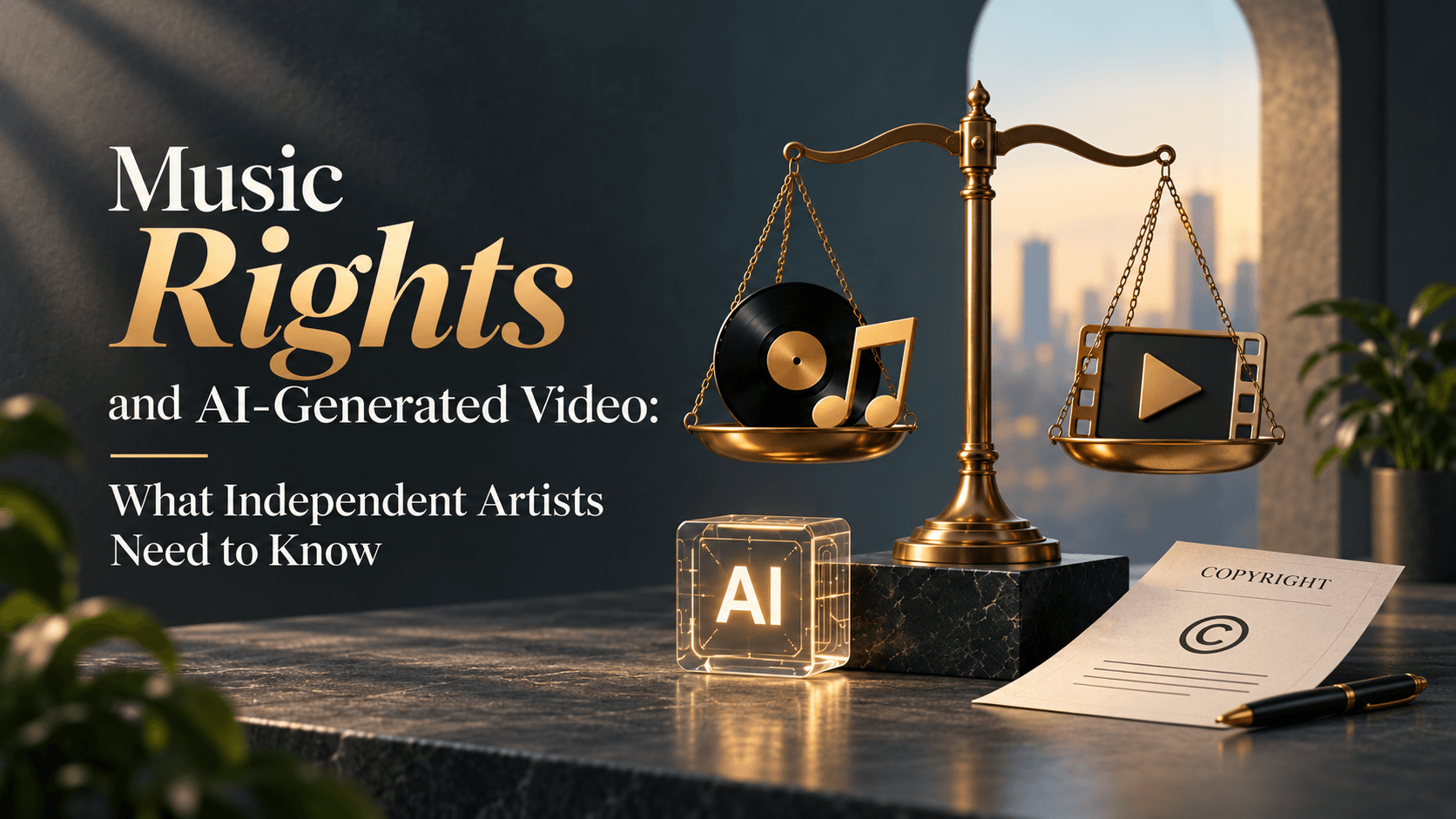


AI does not give you a copyright shortcut. If you put a song behind AI-generated visuals, the music still has to be cleared just as it would for a traditionally produced music video.
For independent artists, the confusing part is that “Do I own this?” is actually several questions. You may own the recording but share the songwriting rights. You may have permission to commercially use AI-generated material without owning copyright in every part of it. You may even have a perfectly valid beat license and still run into trouble with YouTube Content ID.
Before releasing an AI music video, check five things: the song, the recording, the AI tool, any real person’s voice or likeness, and the platform where you will publish it.
This guide uses U.S. copyright law as its legal baseline. It is practical information, not legal advice, and rules can differ by country.
Music rights and AI-generated video: the five checks that matter
A typical song can involve two separate copyrighted works: the musical work, meaning the melody, composition, and lyrics, and the sound recording, meaning the particular recorded performance.
The U.S. Copyright Office treats those as separate works. When music is synchronized with video, permission relating to the composition is commonly called a synchronization or sync license. Permission to use someone else’s specific recording is commonly called a master use license. Source: U.S. Copyright Office.
AI adds more questions on top of those traditional music rights.
Here is the distinction worth remembering:
Permission to use something, copyright ownership, and platform eligibility are not the same thing.
A contract can give you permission to publish an AI-generated asset without making every generated element copyrightable. And you can legally use a non-exclusive beat while still being unable to treat that beat as exclusively yours for Content ID.
[IMAGE: Original “Five-layer rights check” graphic showing Composition → Master → AI tool → Voice/identity → Platform.]
Can you use your song in an AI-generated video? Find your situation
You do not need to become a copyright lawyer before releasing a music video. Start with the situation that actually describes your track.
If you wrote and recorded the entire song yourself
This is the simplest starting point.
If you wrote the composition, recorded the master, used no samples, and have not transferred relevant rights, there may be nobody else from whom you need a music license simply because you are turning your own track into a video.
Still, check the paperwork around the recording. Paying a producer does not automatically tell you what the producer owns. A featured performer agreement, producer deal, publishing administration agreement, or prior rights assignment can change the picture.
A useful test is: Could you authorize a filmmaker or brand to use this exact recording tomorrow without asking anybody else?
If the answer is no, work out who else controls the relevant rights before releasing the video.
If you used a leased beat
Read the license you actually bought.
Do not stop at “commercial use allowed.” Check whether it permits an official music video, monetized YouTube uploads, paid social advertising, distribution through your label or distributor, and the audience or revenue level you expect.
Then look for Content ID language.
This matters because YouTube requires exclusive rights in material submitted as a Content ID reference. YouTube specifically identifies content licensed non-exclusively from a third party as ineligible reference material. Source: YouTube Content ID.
So you can have a legal right to release a song built on a non-exclusive beat and still not have the exclusivity required to claim that beat against everybody else.
If you recorded a cover song
The permission that lets you distribute an audio cover does not automatically give you the right to synchronize that song with video.
The U.S. Copyright Office states that the compulsory mechanical license does not apply to audiovisual works. Synchronization rights are separate, and there is no compulsory sync license that automatically clears a composition for your music video. Source: U.S. Copyright Office.
If you made your own recording, you are not using the original artist’s master recording. But you are still using someone else’s composition.
That is the distinction that catches many independent artists.
If your track contains a sample or interpolation
A sample copies actual audio from an existing recording. An interpolation re-records part of an existing composition instead.
That difference affects what rights may be involved.
A sample can implicate both the sampled sound recording and the underlying musical work. An interpolation does not copy the original master, but it can still require permission for the underlying composition.
The U.S. Copyright Office provides a useful musician-focused guide to samples, interpolations, beat stores, and preexisting music. Source: U.S. Copyright Office.
Putting AI-generated visuals over an uncleared sample does not make the sample cleared. Neither does asking AI to remix, transform, extend, or restyle it.
If you use stock or “royalty-free” music
“Royalty-free” does not mean “free of rules.”
It normally describes a licensing arrangement. The license may still control commercial advertising, client work, platform distribution, geographic use, templates, resale, or Content ID.
Keep the license you received when you obtained the track. Do not rely on a pricing page that may look different six months from now.
Commercial permission, copyright ownership, and exclusivity are different rights questions
This is where AI makes the subject harder.
Suppose an AI service says you can commercially use the song, video, image, or other output you generated. That tells you something important about your contractual permission from the service.
It does not necessarily answer two other questions: how much of the resulting work can you claim as your own copyright, and do you have the exclusive rights required by a distributor or rights-management system?
The U.S. Copyright Office’s current position is that generative AI output can be protected by copyright when a human author determines sufficient expressive elements. Human-created material that remains perceptible, as well as sufficiently creative human selection, arrangement, or modification, can qualify. Merely supplying prompts, by itself, is not enough under the Office’s current guidance. Source: U.S. Copyright Office, AI Copyrightability Report.
That creates a practical spectrum.
If you wrote the lyrics, composed the melody, performed the vocals, arranged the track, and used AI for limited assistance, substantial human-authored material may be easy to identify.
If you typed one prompt and accepted a fully generated song without further creative authorship, the U.S. copyright analysis is very different.
For independent artists, the best habit is to document the human work:
- lyric and melody drafts;
- demos and voice memos;
- MIDI or project files;
- human-recorded vocals and instruments;
- arrangement decisions and stems;
- editing history;
- AI prompts and generated versions;
- the terms or license that applied when the AI material was created.
Those records are useful if a publisher, distributor, collaborator, client, or copyright registration process later asks what you actually created.
What if the AI output resembles an existing song?
Do not assume “the AI generated it” settles the matter.
Listen critically before release. If an output reproduces recognizable lyrics, melody, recorded material, or another protected element, investigate it rather than treating the tool as a legal shield.
The U.S. Copyright Office also emphasizes that there is no universal minimum number of notes, seconds, or percentage of a song that is automatically safe to copy. Source: U.S. Copyright Office.
When something sounds uncomfortably familiar, regeneration is often cheaper than building a release around a rights dispute.
Sync and master rights: what actually changes when music becomes video
Audio distribution and audiovisual use are not identical licensing situations.
When a musical work is placed in timed relation with visuals, the composition side is commonly handled through synchronization rights. When you use someone else’s existing recording, the recording side is commonly handled through a master use license.
A simple way to see it:
- Your original song + your original recording: you may control both sides yourself.
- Your cover + your own new recording: you control your recording, but the underlying composition still belongs to its rightsholder.
- Someone else’s original recording: the composition and the existing master can involve separate permissions.
- Your song with a third-party sample: your track may introduce rights from the sampled master and composition.
This is why the phrase “I have permission to release the song” is not always enough.
Ask whether the permission covers video.
What about fair use?
Fair use exists, but it is not a fixed “use under X seconds” rule.
The U.S. Copyright Office says there is no legal rule permitting a specific number of musical notes or percentage of a work. Fair use depends on the circumstances and statutory factors. Source: U.S. Copyright Office.
For an artist building an official music video, visualizer, promotional Reel, or ad around somebody else’s song, “I only used a short piece” is not a reliable clearance strategy.
If your commercial release depends on a fair-use argument, that is a good point to get individualized legal advice.
AI voices and digital replicas need their own check
A copyright-cleared song can still create problems if the AI performance realistically imitates a real person.
Think beyond celebrity face swaps. The issue can include a synthetic singer who unmistakably sounds like a known artist, an AI avatar built to resemble someone, or a generated performance that implies a real person’s participation or endorsement.
The U.S. Copyright Office has treated unauthorized digital replicas of people’s voices and appearances as a separate policy issue from ordinary copyrightability. As of September 2026, federal NO FAKES legislation has been introduced but is not listed by the Copyright Office among enacted legislation. State laws and other legal theories can also matter. Source: U.S. Copyright Office legislative tracker.
For a working artist, you do not need to wait for every legal question to be resolved before adopting a sensible rule:
If a generated voice, face, or performance is supposed to be recognizably someone else, get permission before making it part of a commercial release.
[IMAGE: Decision graphic showing “AI style inspiration” on one side and “recognizable real person’s voice/likeness” on the other, with the latter routed to permission/legal review.]
YouTube, Content ID, and TikTok can still trip you up
Clearing the copyright side is only part of publishing. Platforms have their own systems.
A legal beat can still cause a YouTube Content ID problem
YouTube Content ID compares uploaded videos against reference material supplied by eligible rightsholders.
For reference material, YouTube requires exclusive rights. Its current policy lists non-exclusively licensed third-party content among material that should not be used as a Content ID reference. Source: YouTube.
This matters for leased beats, stock loops, production-library material, and other assets that many creators can legally license.
The practical distinction is: Licensed to use does not necessarily mean exclusive enough to claim.
Why can your own song claim your own YouTube upload?
Sometimes the claim comes from your distributor or rights administrator.
If that company administers your recording through Content ID, its system can identify your official upload too. YouTube allows eligible Content Manager partners to exempt channels from future Content ID claims through an allowlist. Source: YouTube.
If your own release is being claimed, check the party named in the claim before assuming somebody stole your music.
TikTok changes the question when the post becomes commercial
TikTok’s current guidance says content promoting a brand, product, or service should use music from its Commercial Music Library because its licenses for music outside that library do not cover commercial use in that context.
TikTok also says that if you use original music or music outside the Commercial Music Library for commercial content, you must confirm that no protected music is involved or that you have obtained the necessary licenses. Source: TikTok.
For independent artists, this becomes relevant when a normal release post turns into a sponsored placement, brand collaboration, merch promotion, or paid campaign.
Never assume that because a sound is selectable inside an app, it is licensed for every use you can make of it.
The six-question pre-release rights check
Before you spend time generating alternate cuts, vertical versions, teasers, and ads, answer these six questions for the master version.
1. Do I control the composition?
Confirm the writers, splits, publisher or administrator, and who can authorize audiovisual use.
If there are multiple writers, “everybody is cool with it” is less useful than written documentation.
2. Do I control this recording?
Check the master ownership, producer agreement, featured performers, label arrangement, samples, and any other third-party recorded material.
You are checking the exact audio file in the finished video.
3. Does every license cover what I am actually doing?
Read licenses according to the real release plan.
Look for video use, monetization, social platforms, advertising, client or label use, territory, term, exclusivity, sublicensing, and Content ID.
A license that works for Spotify distribution may not answer every question about a paid video campaign.
4. Do the AI tool’s terms cover my workflow?
Check two directions: input and output.
Make sure you are comfortable uploading the material you are providing to the AI service. Then check what the service permits you to do with generated output.
For example, Renderforest currently states that paid subscribers receive commercial rights to AI-generated images and videos, while free-plan content is intended for personal, non-commercial use. Source: Renderforest.
That commercial permission does not replace the rights you need in music, samples, performances, or other material you bring into the project.
5. Is any real person’s identity being replicated?
Review voices, faces, performers, avatars, and endorsement-like scenes.
If the selling point of the generation is that viewers will think, “That sounds exactly like Artist X,” treat that as a rights question, not simply a creative effect.
6. Will the platform or distributor accept this rights setup?
Check Content ID eligibility, commercial-music restrictions, distributor requirements, advertising rules, and any platform-specific disclosures relevant to your release.
Then save the evidence. A basic rights folder can contain:
- split sheets;
- publishing approvals;
- producer and featured-artist agreements;
- beat licenses;
- sample or interpolation clearances;
- stock licenses;
- AI subscription or license records;
- consent or release forms;
- distributor correspondence;
- records of Content ID disputes or exemptions.
That folder is much easier to assemble before release day than after a claim arrives.
[IMAGE: Saveable “Six questions before releasing your AI music video” checklist with six yes/no checks.]
Where an AI music video generator fits into the rights workflow
Once the song itself is cleared, AI can dramatically reduce the production work required to build visual content around it.
Renderforest’s AI music video generator lets artists upload a track and generate visuals around its lyrics, mood, rhythm, and structure. The current workflow also brings multiple AI video models and editing into one environment, which can be useful when you want to experiment with a visual direction without managing several separate generation tools.
But the order matters:
Clear the music first. Generate at scale second.
If you are still figuring out the production side, Renderforest’s guide on how to generate a music video with AI covers the creative workflow separately. This article is intentionally focused on the rights decisions that come before publishing.
When you need a music lawyer rather than another search
Most fully self-owned independent releases do not need to become expensive legal projects.
Professional clearance help becomes more valuable when the uncertainty is attached to something important: a recognizable sample, a major composition, a label-owned master, disputed co-writer rights, a significant brand campaign, a realistic AI replica of another person, or a release whose economics depend on exclusive rights you may not have.
Get help when you cannot confidently answer who owns it, who can authorize it, or whether your license covers the use.
The more money, reach, or third-party intellectual property involved, the less attractive guesswork becomes.
Frequently asked questions
Can I use my own song in an AI-generated video?
Usually, if you control the necessary rights in both the composition and recording. Check co-writers, publishers, producers, labels, samples, leased beats, and featured performers before assuming “my song” means “100% controlled by me.”
Do I need a sync license if AI created the visuals?
The fact that AI generated the visuals does not create a special exception. If you need permission to synchronize someone else’s protected composition with video, AI-generated visuals do not remove that requirement.
Does paying for an AI video generator clear the music I upload?
No. A platform’s commercial-use terms for generated output do not automatically grant you copyright or licensing rights in third-party music, samples, recordings, voices, or other material you upload.
Can an AI-generated song be copyrighted?
Under current U.S. Copyright Office guidance, protection depends on human authorship. AI assistance does not prevent copyright protection for human-created expression, but material whose expressive elements are determined by the machine is treated differently. Prompting alone is not automatically enough. Source: U.S. Copyright Office.
Can I put a leased beat in YouTube Content ID?
A beat license may let you release and monetize a track without giving you exclusive rights. YouTube requires exclusive rights for Content ID reference material, so check both your beat license and your distributor’s Content ID requirements before opting in. Source: YouTube.
Clear once, then create freely
AI makes it easy to turn one song into a full music video, visualizer, vertical cut, teaser, looping clip, and ad. That speed is valuable, but it also means one rights mistake can spread into every version you publish.
Before generating ten assets, clear one rights chain: composition, master, AI terms, identity, and platform use.
Once those pieces are in order, the creative part gets much simpler. You can spend your time deciding what the music should look like instead of wondering who can claim it after release.