
AI
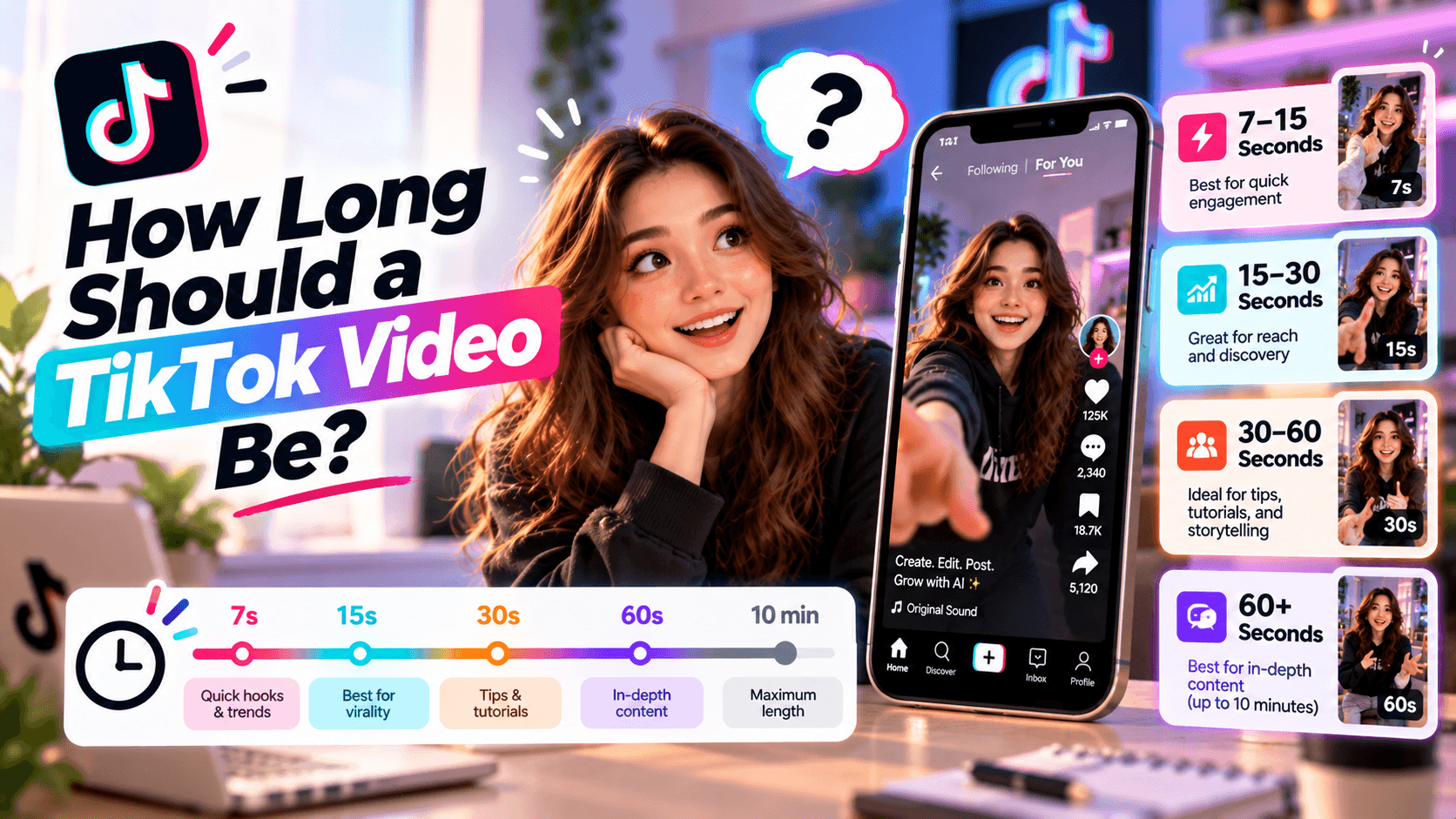
For most organic TikToks, start with 15–35 seconds. Use 30–60 seconds for tutorials, product demos, and explainers. Use 60–180 seconds only when the video has enough structure, proof, and payoff to keep people watching.
TikTok allows much longer videos, but maximum length is not the same as best length. A 12-second video can feel slow if the hook is weak. A two-minute video can work if every section earns the next watch.
The best TikTok video length is the shortest complete version of the idea. This guide shows you how to choose that length by goal, format, pacing, ad use case, and viewer intent.
Most TikTok videos should be 15–35 seconds if the goal is reach, discovery, or quick engagement. Use 30–60 seconds when the viewer needs steps, proof, product context, or a short explanation. Use longer videos only when the content has a clear structure and keeps delivering something new.
A better question than “How long should this be?” is:
What would the viewer lose if I cut 10 seconds?
If the answer is “nothing,” cut it.
TikTok’s video limits have expanded over time, which is why the length question can get confusing. There are three separate questions:
Those answers are not the same.
The platform may give you 10, 30, or 60 minutes. The viewer does not owe you that time.
Use the TikTok Length Ladder before you script. It helps you match the idea to the viewer’s patience.
This framework matters because TikTok is no longer only short clips. It supports quick jokes, search-friendly tutorials, product-led videos, photo posts, and longer storytelling. A single length rule will fail because viewer intent changes.
A viewer might watch a 90-second video called “Why your ads stop working after three days” if the creator proves the point quickly. The same viewer may skip a 20-second video called “Marketing tips” because it sounds generic.
Length is not the strategy. Density is the strategy.
Start with the job of the video. Then choose the length.
If your goal is reach, reduce friction. If your goal is trust, give the viewer enough substance. If your goal is conversion, show the product or promise early.
A video is not too long because the timestamp says 52 seconds. It is too long when the viewer gets the point at 18 seconds and nothing new happens after that.
Quick tips should move fast. Use one problem, one answer, one example.
Good for:
Example structure:
Do not stretch a quick tip into a tutorial. If the idea has one moving part, keep it short.
Product videos need enough time to show the product clearly, but not enough time to become a sales pitch.
A strong product demo usually needs:
Example hook:
If your desk always looks messy by noon, check this before buying another organizer.
For ecommerce, show the product doing something. For SaaS, show the workflow. For local businesses, show the experience. The viewer should understand the product faster than they would from a product page.
Tutorials need breathing room. If you make them too short, the viewer may understand the result but not the process.
Use 30–60 seconds when the tutorial has:
Example structure:
If the tutorial needs more than 60 seconds, add chapters inside the video. Do not just keep talking.
Stories need a setup, tension, and payoff. That usually takes more time than a quick tip.
A strong TikTok story usually has:
Example hook:
We almost deleted this product page. Then one customer message changed the whole angle.
Stories fail when the setup is too long. The viewer does not need your whole backstory. They need the moment that makes the story worth hearing.
Educational TikToks can be longer when they are specific and structured. The key is to make the video feel like a lesson with chapters, not a monologue.
Good topics for longer educational videos include:
Use a chapter-style structure:
For educational content, longer can work. Loose cannot.
For TikTok ads, check the specific ad format before producing creative. TikTok ad specs vary by placement and setup. TikTok’s Auction In-Feed Ads documentation says Spark Ads Pull can have no listed video-duration restriction when pulling eligible organic content, while other ad formats have their own requirements. Source: TikTok Ads Help Center: Auction In-Feed Ads.
For most small business ad creatives, start here:
Do not make one ad and hope length solves everything. Make short, medium, and slightly longer versions. Let retention and conversion data choose.
Before posting, test your TikTok video at three points.
If your 3-second mark is weak, the length does not matter. People may leave before the video begins.
If your 15-second mark has no value, the video is probably too slow.
If your 30-second mark repeats the intro, cut or restructure.
This test is especially useful when editing AI-generated scripts. AI often adds a polite setup before the useful part. On TikTok, the useful part should come first.
Sometimes the problem is not the length. It is the pacing.
This is where editing judgment matters. A 40-second video with constant progress can feel shorter than a 12-second video that says nothing new.
Do not ask only, “Can I make this 60 seconds?” Ask, “Where does the viewer stop getting new value?”
Best for: discovery, simple advice, creator tips.
Example:
Your product video does not need more effects. It needs one clearer use case. Show the product solving one problem, then stop.
Best for: ecommerce, SaaS, local business, creators selling templates or services.
Example:
If you keep losing content ideas, start with one customer question. Here is how one question becomes five TikToks.
Best for: how-to content, software walkthroughs, repeatable processes.
Example:
Here is how to turn one product photo into three TikTok angles: demo, mistake, and buying guide.
Best for: education, B2B, service businesses, complex products.
Example:
Your TikTok is not too long. It is slow because the first 10 seconds explain what the viewer already knows.
Best for: founder stories, client lessons, creator narratives.
Example:
We changed one line in the product demo, and suddenly the offer made sense.
AI is useful for creating versions. It is not good at knowing which version your audience will finish.
Use AI to create three cuts of the same idea:
Prompt:
Turn this TikTok idea into three scripts: a 15-second version, a 30-second version, and a 60-second version. Keep the hook direct, remove filler, and make each version feel complete. Topic: [paste idea].
Then review the outputs manually.
Ask:
If you are producing videos with AI, Renderforest’s AI TikTok Video Generator can help turn a script or idea into a vertical TikTok-style draft. The useful workflow is to generate different length versions, then choose based on hook clarity, pacing, proof, and payoff rather than picking the longest script because it has more words.
Most TikTok videos improve when cut. The goal is not to make the video short at any cost. The goal is to remove anything the viewer does not need.
Cut these first:
Keep these:
A good edit often removes 20–30% of the first draft.
Start with the viewer’s need. A product comparison needs more time than a one-line tip.
Short videos can travel fast, but not every idea survives compression. Some topics need explanation, proof, or a slower reveal.
A long TikTok needs chapters. If the viewer cannot sense progress, the video feels longer than it is.
A delayed payoff only works if the setup creates tension. If the intro is vague, people leave before the reveal.
A viewer may watch a slow video for 40 seconds and still not trust you. Retention matters, but so does usefulness.
AI scripts often sound complete but move too slowly. Cut the setup, sharpen the hook, and replace generic lines with real examples.
Organic videos can build slowly if the story is compelling. Ads usually need to make the problem, product, and next action clear much faster.
Use these as starting points, not rules. The right length is the one your audience finishes without feeling rushed or bored.
Before you post, ask:
The best TikTok length is not the shortest possible duration. It is the shortest complete version of the idea.
For many TikTok videos, start with 15–35 seconds. This range is long enough to deliver a useful idea but short enough for discovery, completion, and rewatch potential. Use longer videos when the topic needs proof, steps, or storytelling.
TikTok’s Help Center currently says videos recorded in the TikTok app can be up to 10 minutes, while uploaded videos can be up to 60 minutes. TikTok Studio currently lists uploads as up to 30 minutes and under 10 GB. Sources: TikTok Help Center: Camera tools and TikTok Help Center: Creator tools.
A 60-second TikTok is not too long if the content has structure. It works well for tutorials, product demos, comparisons, and educational videos. It feels too long when the hook is slow, the middle repeats itself, or the payoff comes too late.
Shorter TikToks can work better for fast reach, jokes, quick tips, and simple visual ideas. But shorter is not automatically better. A short video with no value still fails. A longer video can work when it gives the viewer a strong reason to stay.
Many TikTok ads work well between 15 and 35 seconds as a starting test, but the right length depends on the ad format, product, placement, and campaign goal. TikTok ad specs vary by format, so check the current requirements before producing final creative. Source: TikTok Ads Help Center: Auction In-Feed Ads.
Start with 20–45 seconds. Use the first few seconds to show the problem or product use case, then demonstrate the product, add one proof point, and finish with a clear next action.
Most TikTok tutorials work well at 30–60 seconds. If the tutorial has more than five steps or needs deeper explanation, consider a 60–180 second version with clear sections.
Post long TikTok videos only when the content earns the length. Long videos work best for detailed education, strong storytelling, interviews, product teardowns, and search-driven topics. Do not make a video long just because TikTok allows it.
Beginners should usually start with 15–35 second videos. This makes it easier to practice hooks, pacing, editing, and clear payoffs without overproducing.
Your TikTok is probably too long if the hook takes more than three seconds, the payoff arrives late, the middle repeats itself, or you can cut 10 seconds without losing meaning.
Share this


Article by: Liana Ziroyan
Liana is a marketing professional with 11 years of experience in digital marketing, content, and product communication. She has a strong eye for visual storytelling and loves turning ideas into engaging campaigns that connect with audiences. With her experience across branding, creative content, and user-focused messaging, Liana enjoys finding simple, effective ways to make products feel clear, useful, and exciting.
Read all posts by Liana Ziroyan