Social Media Marketing
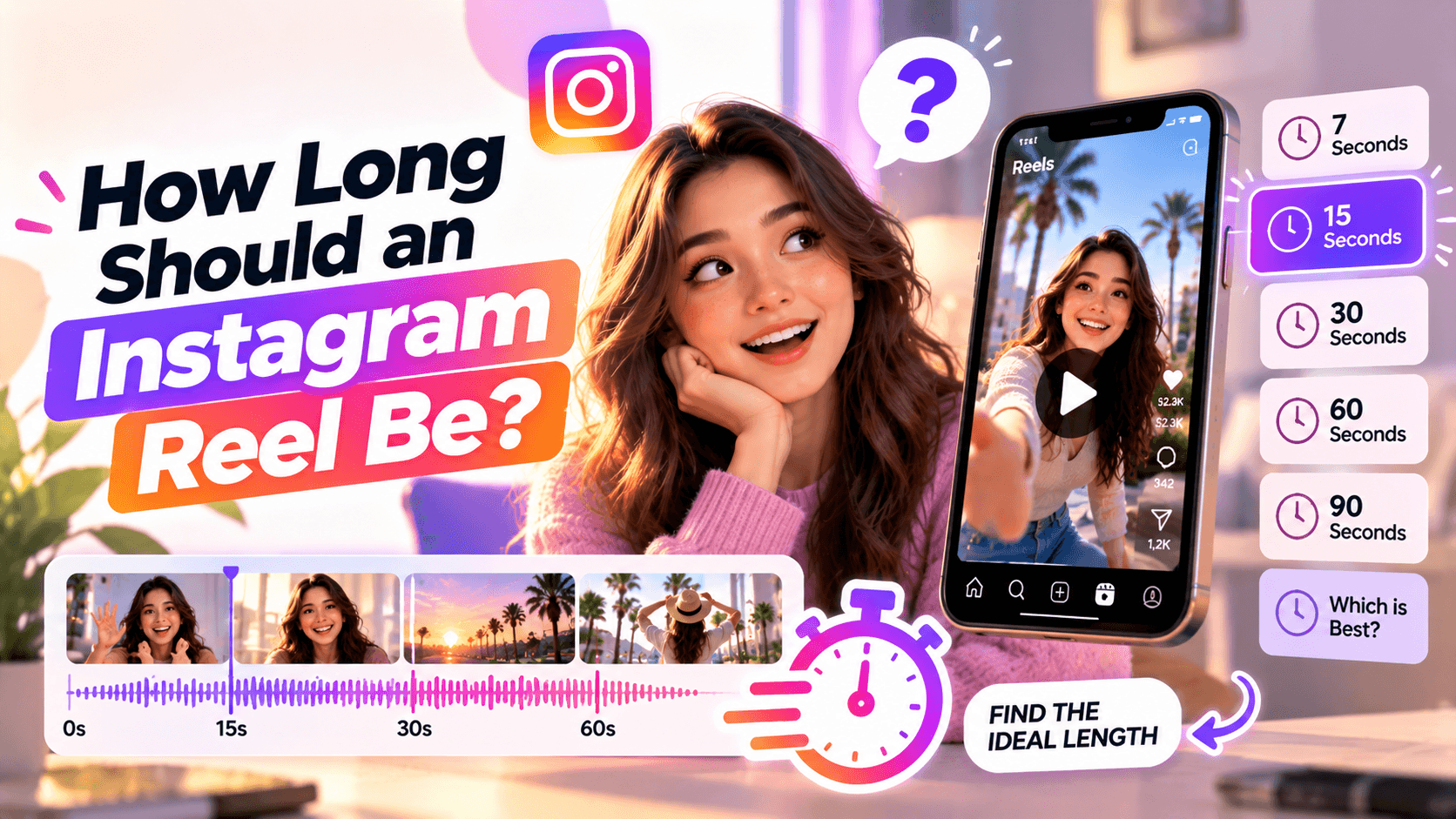
How long should an Instagram Reel be? For most creators and businesses, aim for 15 to 30 seconds when you want reach, 30 to 60 seconds when you are teaching or demonstrating something, and 60 to 90 seconds when the Reel needs a story, expert answer, or more context.
Instagram now allows longer Reels than it used to. In January 2025, Instagram expanded Reels uploads to up to 3 minutes, doubling the previous 90-second limit, according to The Verge’s coverage of Adam Mosseri’s announcement. But the maximum length is not the same as the best length.
A 10-second product reveal can work better than a 90-second explanation if the idea is visual. A 60-second tutorial can work better than a 15-second tip if people need the steps. The right Reel length is not the longest Instagram allows. It is the shortest length that fully delivers what the hook promised.
Use this as your starting point:
The most useful rule is simple:
One Reel = one promise = one payoff.
If the promise is “watch this logo appear,” you might need 8 seconds. If the promise is “here are three mistakes hurting your Reels,” you might need 40 seconds. If the promise is “watch me turn one long video into five Reels,” you may need 60 to 90 seconds.
Do not choose the length first. Choose the job of the Reel first.
Instagram Reels can be up to 3 minutes long, based on Instagram’s January 2025 expansion reported by The Verge and Social Media Today. Before that update, Reels were commonly limited to 90 seconds.
That does not mean every account, workflow, or upload path will behave exactly the same. Platform limits can vary by app version, region, account type, upload method, and whether you record inside Instagram or upload an edited video. Before creating a production spec for a client or campaign, check the Reel composer in the Instagram account you plan to publish from.
Here is the practical distinction:
The ceiling gives you flexibility. It should not become your default.
This is where many Reel length guides become misleading.
The maximum length answers a technical question. The best length answers an audience question.
A viewer does not care that Instagram gives you 3 minutes. They care whether the video rewards their attention quickly enough. If your first 3 seconds are vague, even a 20-second Reel can feel too long. If your story is useful, well-paced, and clearly structured, a 75-second Reel can feel short.
Instagram has also given creators signals that shorter Reels still matter for discovery. In 2024, The Verge reported that Instagram’s professional dashboard best-practices hub included guidance that Reels longer than 90 seconds may not be recommended to new users in the same way. That does not mean longer Reels are useless. It means longer Reels need a stronger reason to exist.
Think of it this way:
The best Reel length is not one number. It is a decision.
Use this rule before editing:
The right Reel length is the shortest runtime that fully delivers the promise made in the hook.
A Reel fails when the promise and payoff do not match.
If your hook says “three mistakes,” the viewer expects three mistakes. If your Reel only explains one, it feels incomplete. If your hook says “quick tip,” the viewer expects speed. If you spend 12 seconds setting up the topic, it feels slow.
Here are a few examples:
This is why the same brand should not make every Reel the same length. A bakery showing a cake reveal does not need 60 seconds. A SaaS company explaining how a new feature saves time might need 45 seconds. A consultant telling a founder story may need 75 seconds.
The content decides the length.
If your goal is reach, keep the Reel short and immediately understandable.
Reach-focused Reels work best when the viewer can understand the topic by the second or third second. The format should feel easy to finish and easy to share.
Best for:
A strong reach-focused Reel usually follows this structure:
Example hook:
“Your Reel is not too long. It starts too slowly.”
This kind of Reel does not need a long introduction. It needs a fast, clear idea.
If your goal is saves, give the viewer something worth coming back to.
Save-worthy Reels usually teach, organize, or simplify something. The content needs enough substance to be useful later, but not so much that it becomes hard to follow.
Best for:
A good save-focused Reel usually follows this structure:
Example hook:
“Save this before editing your next Reel.”
The viewer should feel that the Reel gives them a repeatable method, not just a passing observation.
If your goal is shares, make the Reel clear enough that someone can send it without explaining it.
People share Reels when the content expresses a feeling, explains a problem, or reminds them of someone. The Reel should be specific enough to feel personal but broad enough to apply to more than one person.
Best for:
Example hook:
“Send this to someone who still opens every Reel with ‘Hey guys.’”
Shared Reels do not need to be long. They need to be instantly understood.
If your goal is clicks, signups, purchases, or DMs, the Reel usually needs more context.
A conversion-focused Reel has to do more than attract attention. It needs to show the problem, explain why the viewer should care, and give enough proof for the CTA to feel natural.
Best for:
A conversion-focused Reel usually follows this structure:
Example hook:
“Here is how to turn one product idea into a finished Reel.”
This is where a tool mention can be useful if it serves the reader. For example, a creator or small business owner can use the Renderforest AI Reel Generator to turn a script, idea, or image into a vertical Reel draft, then edit the visuals, text, music, timing, and branding before posting.
Community-focused Reels can be longer because people already have a reason to listen.
These Reels are less about cold discovery and more about deepening the relationship with existing followers.
Best for:
Example hook:
“We changed one thing about how we make Reels.”
These Reels should still be edited tightly. Community does not excuse slow pacing. It only gives you a little more room.
Trends work because they are easy to recognize. The viewer already understands the format, so you do not need much setup.
Keep the Reel short. Deliver the joke, contrast, reveal, or relatable moment quickly.
Best structure:
Familiar setup → twist → loop
Example:
“When the client says, ‘Just make it go viral.’”
Suggested length: 7–12 seconds.
Product reveals should be visual. Do not explain what the viewer can see.
Best for:
Suggested length: 8–15 seconds.
If the product is simple, keep it short. If the product needs explanation, make a separate demo Reel instead of stretching the reveal.
A demo needs enough time to show the problem, action, and result.
Best structure:
Problem → feature/action → result
Example:
“Turn one product photo into a 15-second promo Reel.”
Suggested length: 25–40 seconds.
Avoid listing every feature. One Reel should show one useful action.
Tutorials need more time because the viewer has to understand the steps.
Best structure:
Outcome → steps → result
Example:
“How to make a Reel from a blog post in under a minute.”
Suggested length: 40–60 seconds.
A tutorial becomes too long when it includes setup steps the viewer does not need. Start where the action starts.
Expert clips need space for setup and credibility. This is especially true for podcast clips, interviews, webinars, and founder content.
Best structure:
Question or tension → answer → example → takeaway
Example:
“Why your best Reel might be buried inside a 40-minute webinar.”
Suggested length: 45–75 seconds.
The key is to cut the clip around a complete thought, not a random quote.
Stories need setup, tension, and resolution. If you cut them too short, they feel incomplete.
Best structure:
Setup → problem → turning point → lesson
Example:
“The first version failed. The second one worked because we changed the hook.”
Suggested length: 60–90 seconds.
A story should move. If nothing changes, it is not a story yet.
Repurposed clips work best when they feel selected, not chopped.
Good repurposed Reels need:
Suggested length: 30–75 seconds.
A strong line from a podcast is not automatically a strong Reel. The viewer needs to understand why the moment matters without watching the full episode.
Ads need to move faster than organic content because the viewer did not ask to see them.
Best structure:
Problem/result → proof → CTA
Suggested length: 15–30 seconds for simple offers and 30–45 seconds for demos.
Avoid slow brand intros. Start with the viewer’s problem or desired result.
Use 7–15 seconds when the idea is simple, visual, or instantly recognizable.
Good examples:
This length works because the viewer can finish the Reel almost without thinking. It can also encourage replays if the loop is clean.
The risk is thinness. A 10-second Reel is great for a visual payoff. It is not enough for a serious tutorial unless the tip is extremely simple.
This is the safest starting range for most creators and small businesses.
It gives you enough room for:
Example structure:
This range is strong because it forces clarity. If you cannot explain the Reel’s idea in 30 seconds, you may be trying to fit too much into one post.
Use this range when the viewer needs more than a quick statement.
Good examples:
A 30–60 second Reel can be more valuable than a short trend because it gives the viewer something to save. Socialinsider’s analysis of Reel length found that longer Reels can perform strongly for views and engagement in some datasets, especially around the 60–90 second range, although the right length still depends on the account and content type.
Do not make this range slow. A 50-second Reel still needs momentum.
Use 60–90 seconds when the Reel needs context, but still belongs in a short-form feed.
Good examples:
This range works best when the viewer has a reason to care early. The first 3–5 seconds need to prove that the longer runtime is worth it.
Bad use of 90 seconds:
A slow introduction, repeated points, and a CTA at the end.
Good use of 90 seconds:
A sharp hook, clear setup, useful explanation, specific example, and memorable takeaway.
Longer Reels can work, but they are not for every idea.
Use this range when:
Good examples:
If the Reel is longer than 90 seconds, structure it like a mini article:
A 3-minute Reel without structure feels like a video someone forgot to edit.
Use this decision table before you open the editor.
Then ask one final question:
Can I cut five seconds without weakening the Reel?
If yes, cut them.
Most Reels do not need less information. They need less delay.
A 20-second Reel can fail in the first 2 seconds. A 75-second Reel can work if the first 3 seconds make the value clear.
The opening should answer at least one of these questions:
Weak openings:
Better openings:
The hook does not need to be dramatic. It needs to be specific.
Best range: 15–45 seconds
Small businesses usually need practical Reels that show the product, explain the offer, or answer common customer questions.
Good examples:
A local bakery does not need a 90-second Reel to show a cake reveal. But it may need 45 seconds to explain how custom orders work.
Best range: 7–30 seconds
Ecommerce Reels should usually be visual and fast.
Good examples:
A longer Reel can work for high-consideration products, but simple products should get to the visual payoff quickly.
Best range: 20–60 seconds
Software often needs more context because the viewer has to understand the interface and the benefit.
Good examples:
A 10-second SaaS Reel can work for awareness. A 45-second Reel is usually better for demos.
Best range: 30–90 seconds
Advice content needs room for context, but it still needs a tight edit.
Good examples:
A consultant can use a longer Reel when the idea is nuanced. But the first line still needs to earn attention.
Best range: 20–60 seconds
Marketing audiences are used to content. Generic advice gets ignored quickly.
Good examples:
The more tactical the Reel, the more likely people are to save it.
Best range: 7–25 seconds
Restaurants and local service businesses often win with visuals.
Good examples:
A 12-second Reel can be enough if the final shot is strong.
Best range: 30–90 seconds
Educational Reels need enough time to teach, but not so much that the viewer feels trapped.
Good examples:
Use longer Reels for topics people are likely to save.
AI can help you create more Reel variations, but it can also make videos longer than they need to be.
Many AI-generated scripts include too much setup. They explain the topic before delivering the value. For Reels, that usually needs editing.
A better workflow is to ask AI for multiple runtime versions of the same idea.
Prompt:
Turn this idea into four Instagram Reel scripts: 10 seconds, 20 seconds, 35 seconds, and 60 seconds. Keep the same core message in each version. Make the hook specific, remove filler, and end with a clear payoff.
Then compare the versions.
Ask:
This is useful because the best Reel length is often easier to feel when you compare versions side by side.
If you are creating Reels from scripts, product ideas, blog posts, or images, tools like the Renderforest AI Reel Generator can help you turn a short brief into a vertical Reel draft. The important part is still the edit: adjust the hook, timing, captions, scenes, music, and CTA so the final video matches the length the idea deserves.
For broader video creation, Renderforest’s AI Video Generator can support text-to-video and image-to-video workflows when a Reel needs additional visuals, narration, or generated scenes.
There is no universal “best length” that works for every account. Your audience, niche, offer, editing style, and content type all matter.
Run a simple 4-week test.
Keep the topic type similar. Do not compare a funny trend to a serious tutorial and blame the runtime. Test similar ideas in different lengths.
Track:
Instagram has shifted toward using views as a primary metric across content formats, according to The Verge’s reporting on Instagram’s metric update. But views alone do not tell you whether the Reel helped your business.
Use the right metric for the goal:
A 12-second Reel may win on views. A 60-second Reel may win on saves or leads. The best length depends on what you want the Reel to do.
Instagram allowing longer Reels does not mean long Reels should be your default.
A 3-minute Reel should be used when the content genuinely needs that time. Most ideas do not.
A slow intro makes any Reel feel long.
Cut lines like:
“I wanted to quickly come on here and talk about…”
Start with the value:
“Your Reel is losing people before the tip starts.”
A product reveal, customer story, tutorial, and founder opinion should not all have the same runtime.
Length should follow the format.
Shorter is not always better. If the viewer cannot understand the idea, the Reel is not efficient. It is incomplete.
A 15-second tutorial that skips the key step will not feel useful.
Views matter, but they are not the whole story.
If your goal is education, saves may matter more. If your goal is sales, DMs and clicks matter more. If your goal is community, comments and replies matter more.
Do not make people wait too long to understand why they are watching.
A strong Reel gives the viewer small payoffs throughout the video, not only at the end.
If your Reel includes three unrelated points, it will probably feel too long.
Split it into a series.
Many people watch with sound off or in noisy places. Captions and visual clarity matter.
If the Reel only works with audio, it may lose viewers who would otherwise stay.
Before publishing, ask:
If the answer is unclear, shorten the intro first.
Most Reels do not need to lose their substance. They need to lose the delay before the substance starts.
For maximum reach, most Instagram Reels should be 7 to 30 seconds. Shorter Reels are easier to finish, replay, and share. Use this range for trends, product reveals, quick tips, and simple ideas.
Instagram expanded Reels uploads to up to 3 minutes in January 2025, based on Adam Mosseri’s announcement reported by The Verge. Because platform limits can vary by account, region, app version, and upload method, check the Reel composer before publishing final production specs.
A 15-second Reel is usually better for reach, trends, and simple visual ideas. A 60-second Reel is usually better for tutorials, product demos, expert answers, and save-worthy educational content. The better length depends on the job of the Reel.
No. Longer Reels can work when they provide enough value to justify the time. They are better for warm audiences, tutorials, stories, product walkthroughs, and expert explanations. They fail when the intro is slow or the idea could have been explained faster.
For discovery, it is usually safer to keep Reels under 90 seconds unless the content truly needs more time. Instagram’s professional best-practices guidance has been reported to favor shorter Reels for recommendations, while the current upload limit gives creators more flexibility.
Educational Reels often work best between 30 and 60 seconds. If the topic needs more context, a 60–90 second Reel can work well, especially when it includes clear steps, examples, and a strong takeaway.
Product Reels usually work best between 10 and 45 seconds. Use 10–20 seconds for product reveals and teasers. Use 20–45 seconds for demos that show the problem, feature, and result.
Instagram Reel ads usually work best when they are direct and fast. Aim for 15–30 seconds for simple offers and 30–45 seconds for product demos or higher-commitment CTAs.
Your Reel is probably too long if the first half repeats the same point, the payoff arrives late, or the video still makes sense after cutting 20–30% of the runtime. Check average watch time, completion rate, and drop-off patterns.
Use a clear hook, remove filler, add visual movement, break the Reel into sections, use captions, show examples, and give the viewer small payoffs throughout the video.
No. Short Reels are useful for reach, but longer Reels can build trust, explain products, teach processes, and convert warmer viewers. Use short Reels for discovery and longer Reels when the idea needs depth.
Most small business Reels should be 15 to 45 seconds. Use shorter Reels for product reveals, behind-the-scenes clips, and quick visuals. Use longer Reels for customer questions, product demos, service explanations, and founder stories.
The best Instagram Reel length is not a fixed number. It is the shortest runtime that fully delivers the promise made in the hook.
Use 7–15 seconds for fast visual ideas, 15–30 seconds for quick tips and reach, 30–60 seconds for education and demos, 60–90 seconds for stories and expert answers, and up to 3 minutes only when the value genuinely needs that much time.
Do not start with the upload limit. Start with the viewer’s reason to keep watching. Then make the Reel long enough to deliver the payoff and short enough that no second feels wasted.
Share this


Article by: Liana Ziroyan
Liana is a marketing professional with 11 years of experience in digital marketing, content, and product communication. She has a strong eye for visual storytelling and loves turning ideas into engaging campaigns that connect with audiences. With her experience across branding, creative content, and user-focused messaging, Liana enjoys finding simple, effective ways to make products feel clear, useful, and exciting.
Read all posts by Liana Ziroyan