AI
A couple of years ago, AI-generated video was mostly a demo reel. Impressive to watch, hard to use in practice, and rarely making it into real work. That has changed. The AI video generation trends in 2026 show up in real campaigns, employee training programs, social content pipelines, and product launches. According to Vivideo, monthly active users across AI video platforms have surpassed 124 million as of January 2026. That is not a niche experiment. That is mainstream adoption.
The conversations that matter now are about control, consistency, and fitting AI video into existing workflows. This article breaks down the AI video generation trends 2026 is bringing into real production and what they mean if you are making video content for your business.
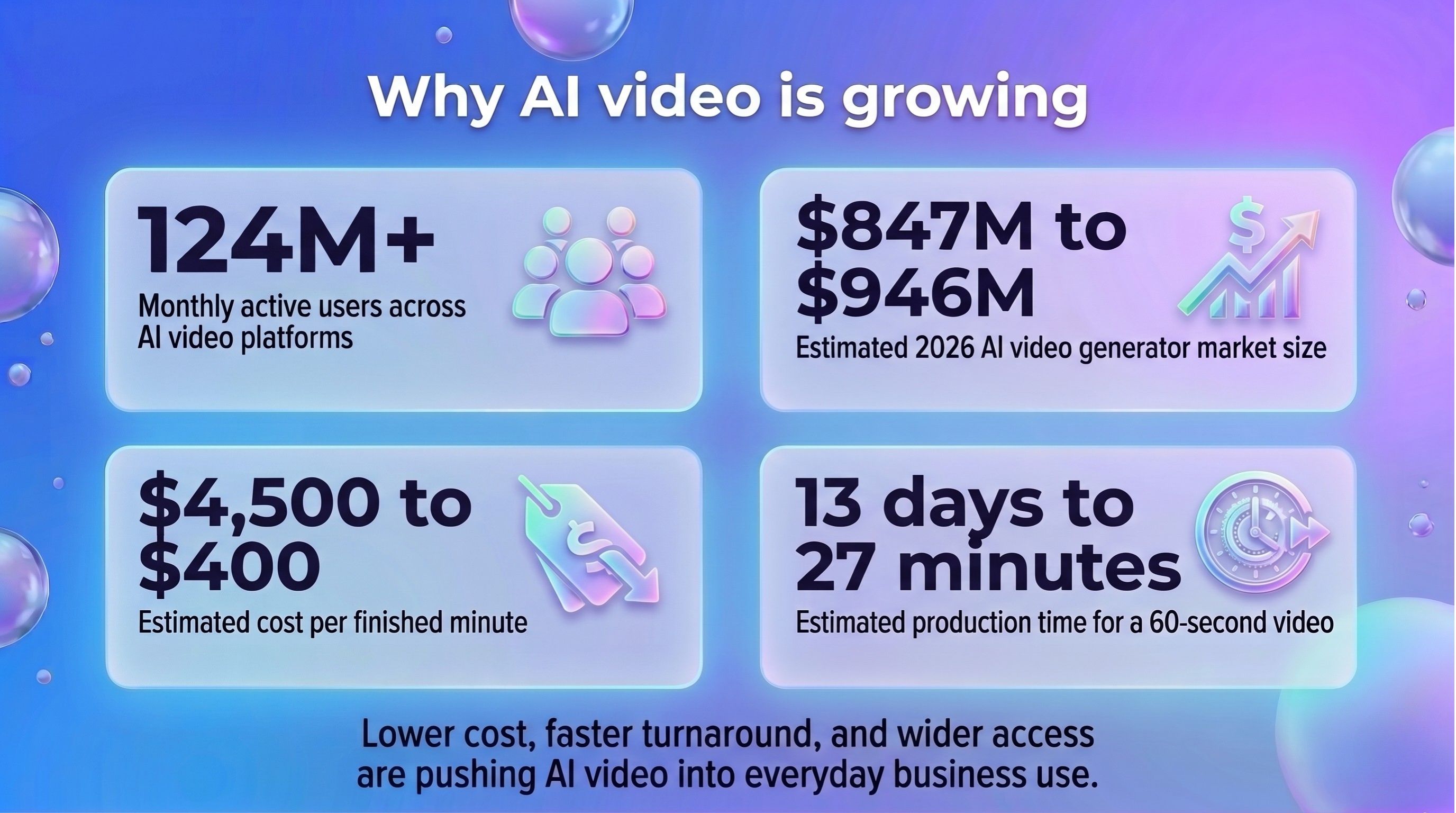
The AI video generation market trends 2026 show a market that has moved well past early adopters. According to Fortune Business Insights, the global AI video generator market is projected to reach $847 million in 2026, up from $716.8 million in 2025, growing at an 18.8% CAGR. Grand View Research puts the 2026 figure slightly higher, at $946 million. The methodologies differ, but both point in the same direction.
The market size is notable, but the more telling story is what changed underneath it. For most of the past decade, producing a decent video required a real budget, a team, and time. Traditional video production runs about $4,500 per finished minute, and a 60-second video took an average of 13 days to go from brief to finished asset. For large organizations with dedicated creative teams, that was workable. For small businesses, freelancers, and lean marketing teams, it was often the reason video got pushed down the priority list.
AI-powered production has brought that cost down to roughly $400 per minute, a 91% reduction, and the same 60-second video now takes around 27 minutes to produce. That shift did not just make AI video creation affordable, it made it accessible to a much wider range of businesses and creators who previously could not justify the time or expense.
That is what is driving the growth. Videos have gone from a resource-intensive production to something a solo marketer or small business owner can turn around pretty quickly.
The AI video generation trends in 2026 go beyond faster rendering and cheaper tools. Here is what is actually shifting, and what it means for the people making video content day to day.
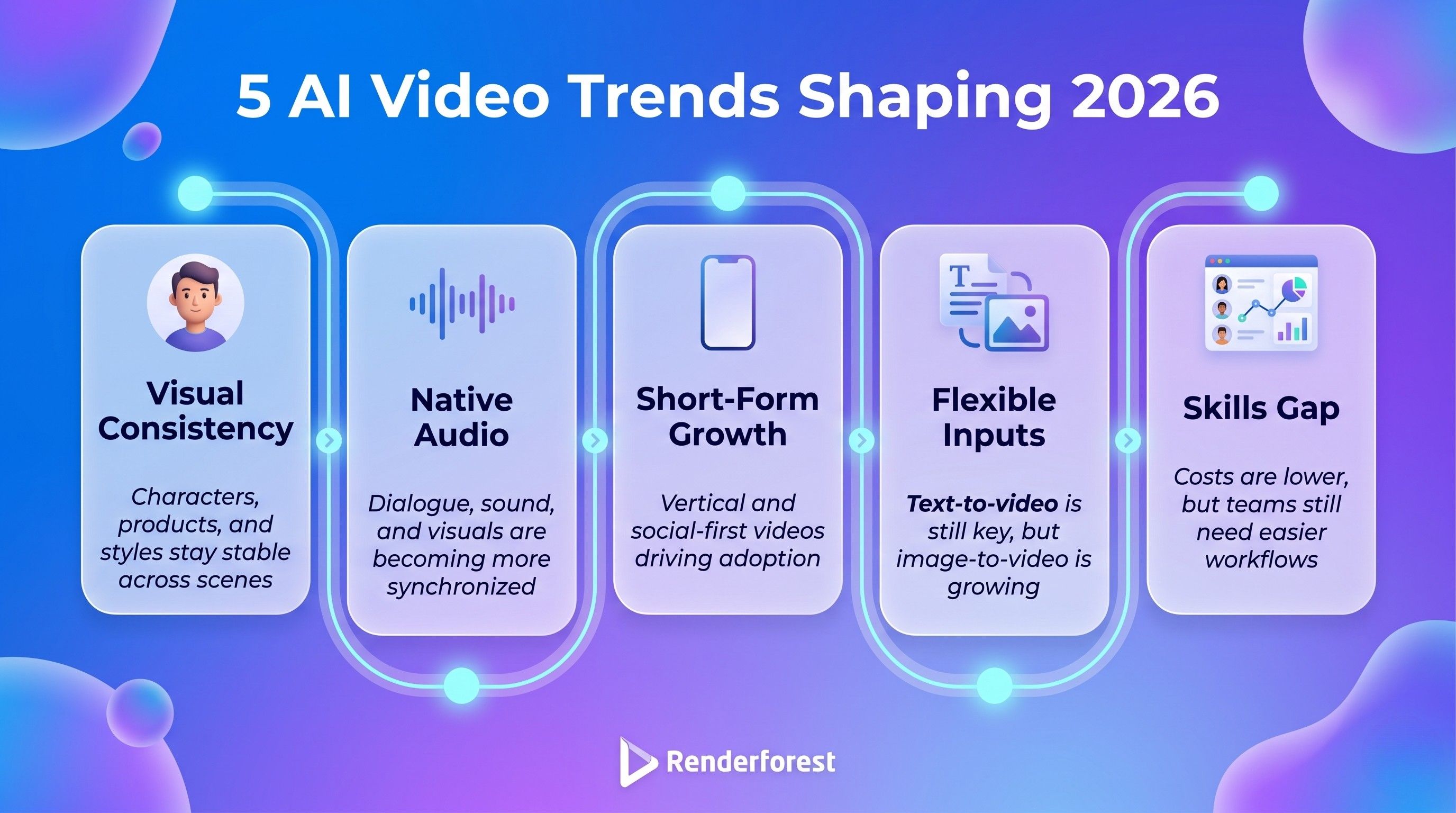
A year ago, keeping the same character, product, or environment stable across multiple scenes was something platforms actively advertised. In 2026, that has shifted: character-consistent AI video has moved from an impressive feature to a baseline expectation for professional work.
For brand work, this matters more than it might seem. A campaign that runs across multiple videos with a recognizable character or consistent visual environment builds familiarity over time. Without that, each video feels like it was made in isolation and the cumulative brand effect is lost. The same applies to episodic content and structured training programs, where viewers need visual continuity to stay oriented across pieces.
Renderforest handles this at the generation level, maintaining style and character consistency across scenes so that a video series or multi-part campaign holds together visually without extra manual work.
For most of the AI video era, generating a clip meant getting silent footage. You would produce a visually solid scene and then piece together voiceover, sound effects, and music in separate tools, often with timing that never felt quite right.
That has changed quickly. A year ago, most top AI video models generated silent video. Recent rankings suggest native audio is becoming more common across leading AI video models. In Kingy AI’s 2026 comparison, most of the top-ranked tools support synchronized audio natively, with Runway as the likely exception.
For teams producing video regularly, native audio can reduce the need to build dialogue, ambient sound, and sound effects separately after generation. It does not remove editing entirely, and pricing tiers or credit limits may still apply, but it can make the first usable output feel much closer to a finished video.
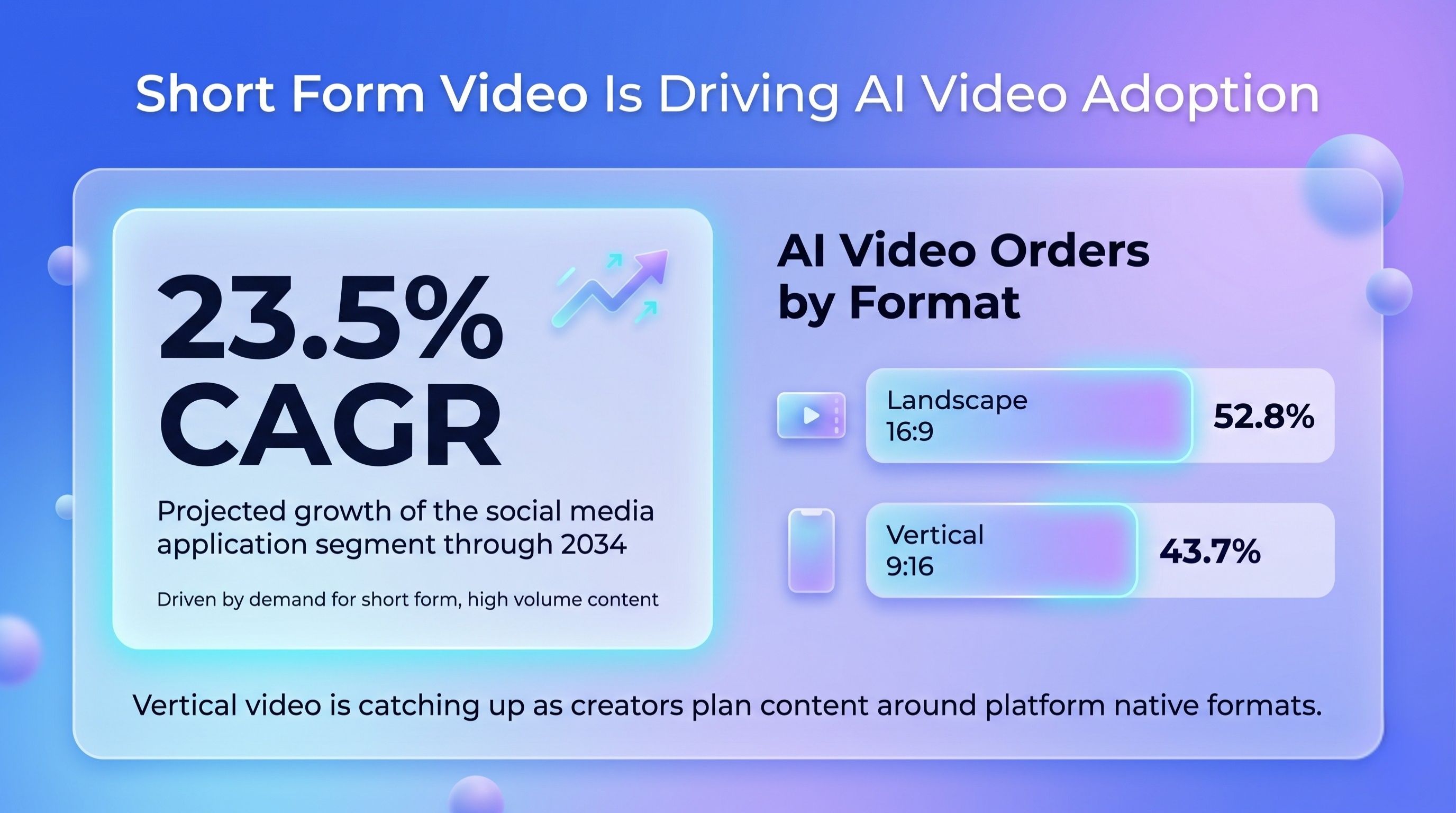
Social media is where AI video adoption is moving fastest. The social media application segment is projected to grow at 23.5% CAGR through 2034, driven by demand for short-form, high-volume content on platforms like TikTok and Instagram.
The market trends in AI video creation in 2026 show that format is becoming just as deliberate as content. Creators are no longer producing one video and hoping it works everywhere. Vertical video at 9:16 already accounts for 43.7% of AI video orders, compared to 52.8% for landscape, and that gap is closing. Given how platform algorithms increasingly favor native formats, the shift toward vertical-first production is likely to continue through the year.
For anyone managing content across multiple channels, this means thinking about aspect ratio and platform fit from the start rather than cropping and reformatting after the fact. AI video tools that support multiple output formats from a single generation make that considerably easier to manage at volume.
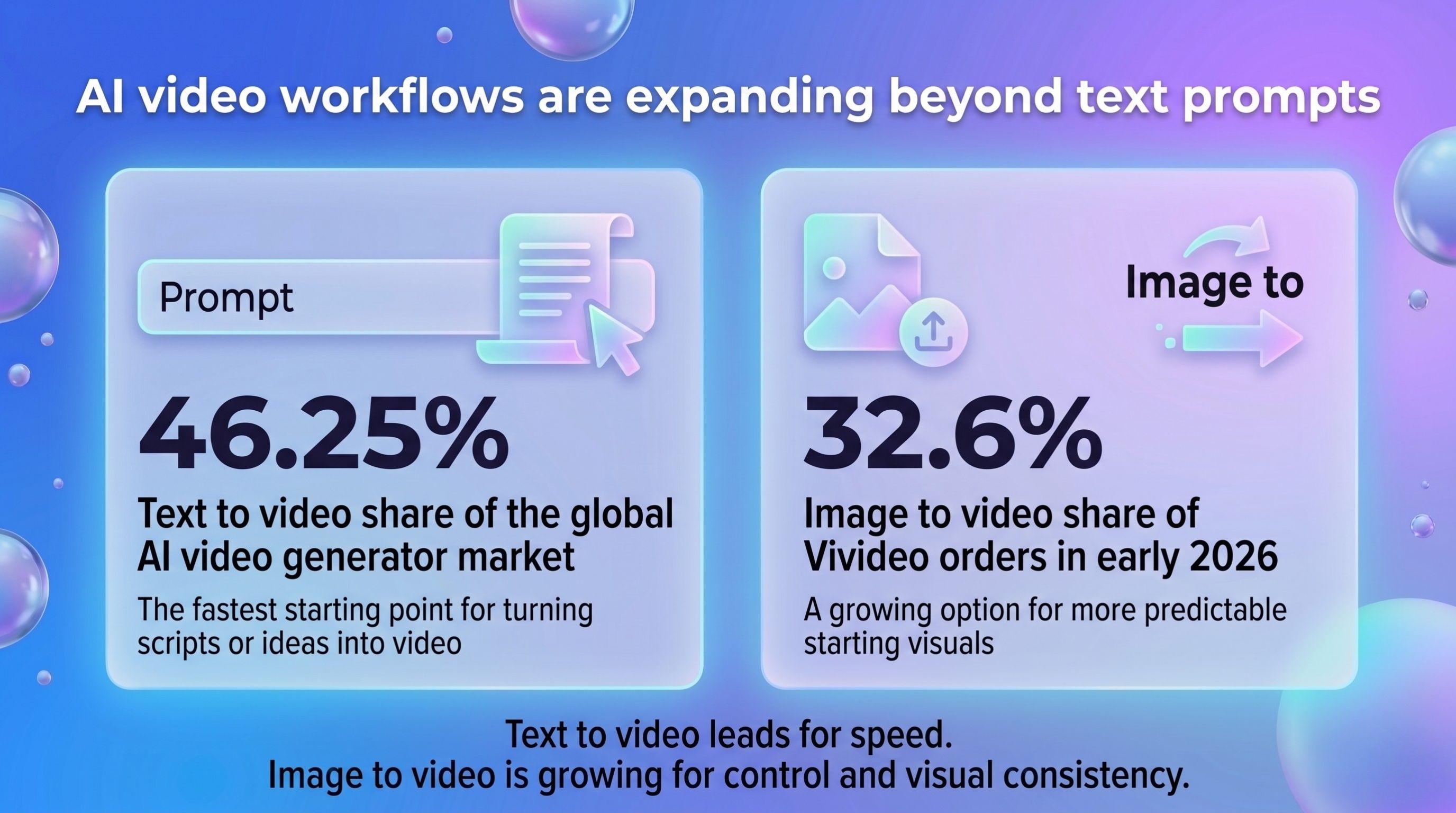
Text-to-video remains the most common starting point. According to Fortune Business Insights, it accounts for 46.25% of the global AI video generator market, driven by its ability to convert scripts or ideas into video quickly and at scale.
But a second pattern is growing alongside it. On Vivideo’s platform in early 2026, image-to-video already made up 32.6% of all orders, suggesting that creators increasingly want more control over their starting visuals rather than leaving everything to a text prompt. The practical difference is straightforward: text-to-video gives you speed, image-to-video gives you more predictable output, which matters when you have specific brand visuals or a product look to maintain.
Renderforest supports both, letting users work from text, stock footage, or AI-generated images depending on what the project calls for.
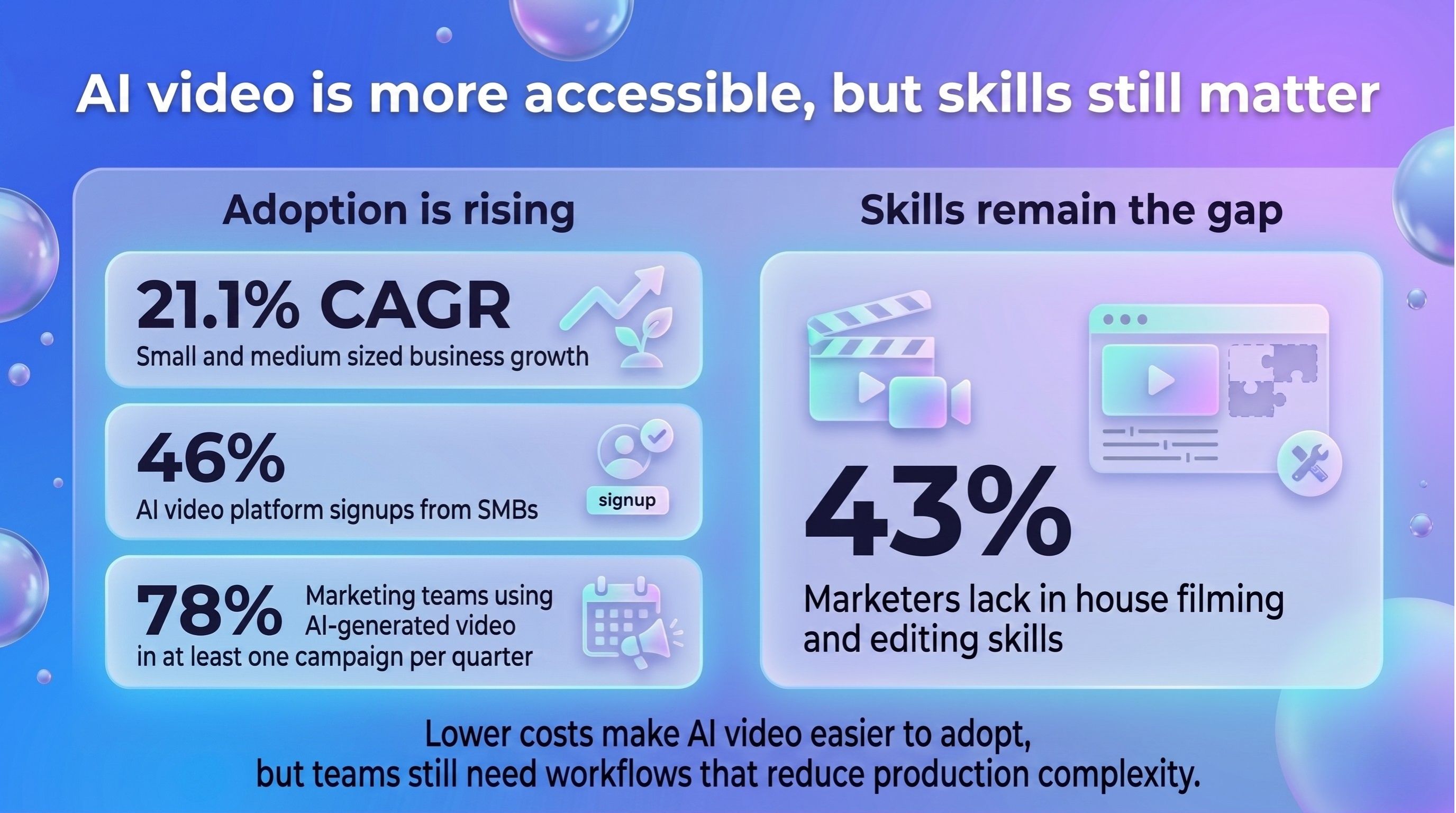
The cost reduction has opened the door for a much wider group of businesses. Small and medium-sized businesses are growing at a 21.1% CAGR and now represent 46% of all AI video platform sign-ups. 78% of marketing teams use AI-generated video in at least one campaign per quarter.
But adoption and confidence are two different things. For many teams, getting started is not the hard part. Knowing how to use the tools well is. The skills gap is not limited to AI video. SellersCommerce reports that 43% of marketers lack in-house filming and editing skills, which helps explain why easier video workflows matter even as production costs fall.
This is where platform design matters. The current trends in AI video creation point toward tools that reduce the skill requirements, not just the price tag. Platforms that handle scripting, scene selection, transitions, and audio in one place make it possible for a marketing manager or HR professional to produce usable video without a production background. That is the gap most businesses are actually trying to close.
The teams getting the most out of AI video right now are not necessarily the ones with the biggest budgets. They are the ones who have identified the content types they produce repeatedly, such as social clips, onboarding videos, or product explainers, and built a repeatable process around those first. That is the most practical starting point.
Format and consistency are worth thinking about from the beginning. With vertical video growing fast and platforms rewarding native formats, deciding upfront what you need and sticking to a consistent visual style across videos will save you a lot of rework down the line.
Renderforest brings multiple creation methods, visual consistency, voiceover, editing, and multi-format output into one workflow. For teams who need to produce video regularly without a dedicated production setup, that is a helpful reduction in the back-and-forth between tools.
A year ago, most of what this article covers was still emerging. Today it is production-ready, and the gap between teams using these tools well and teams still figuring out where to start is growing. Visual consistency, native audio, flexible input methods, and dramatically lower costs are all on the table right now.
The most useful thing you can do is stop reading about it and start testing it. Try Renderforest’s AI video tools and see what your team can actually produce.
Estimates differ depending on the source. Fortune Business Insights puts the global AI video generator market at $847 million in 2026, while Grand View Research estimates $946 million. The gap comes down to methodology, but both point to a market growing at roughly 19 to 20% annually and heading past $3 billion by the early 2030s.
Marketing and advertising leads in application, accounting for 33.88% of all AI video use, followed by media and entertainment with a 23.87% industry share. Social media is the fastest-growing segment, driven by demand for short-form, high-volume content on platforms like TikTok and Instagram. Source: Fortune Business Insights.
For most business use cases, yes. Marketing content, training videos, product explainers, and social clips are all areas where AI video produces solid results today, at a fraction of traditional production costs. For broadcast, film, or highly customized commercial production, traditional production still offers more control. For everyday business content, AI video is already practical enough for many workflows. For most teams, the bigger obstacle is not output quality but having the in-house skills to use the tools well.
Text-to-video generates footage directly from a written prompt, making it the quickest path from idea to finished clip. Image-to-video animates or extends a still image, giving creators more control over the visual starting point. Text-to-video still dominates, but image-to-video made up 32.6% of orders on one major platform in early 2026 as more creators look for predictable, brand-consistent output.
The ones that matter most for business users: visual consistency across scenes is now a baseline expectation, native audio is removing a significant post-production step, short-form and vertical video are leading adoption, and input methods are becoming more flexible beyond text prompts. Production costs have dropped sharply, but building the in-house skills to use these tools consistently remains the main gap for most teams.
Share this


Article by: Sara Abrams
Sara is a writer and content manager from Portland, Oregon. With over a decade of experience in writing and editing, she gets excited about exploring new tech and loves breaking down tricky topics to help brands connect with people. If she’s not writing content, poetry, or creative nonfiction, you can probably find her playing with her dogs.
Read all posts by Sara Abrams